

I stepped out of the shower and caught myself in the mirror.
Damn…I still had man tits.
I stood there, dripping on the bath mat, staring at a body that had apparently been ignoring all the effort I put in. I wasn’t overweight. I had some muscle on my frame, somewhere underneath. But I was skinny fat. Like someone had taken a reasonably fit person and added a few softer layers.
Seven years. I’d been going to the gym for more than Seven. Fucking. Years. and I still didn’t look like I went to the gym.
I was showing up. Three, four times a week. I’d lift heavy shit, then I’d put the heavy shit back down, again and again. I thought that was the deal. You show up, you move the weight, your body changes. Isn’t that what everyone says? “Consistency is everything.”
Turns out consistency gets you exactly what you consistently do. And what I was consistently doing was working hard enough to feel like I’d worked out, but not doing what actually changes anything.
I didn’t know that at the time. I thought I was doing it right. I ate all the healthy foods, did the cardio, cut out alcohol. But I still looked the same in every photo. So, I started to convince myself it was just slow progress, or bad genetics, or that maybe this was just what my body wanted to be.
I had no idea what I was doing wrong. I’d been at this for years and I couldn’t tell you why it wasn’t working or I just wasn’t smart enough to change what I was doing.
So, reluctantly, I finally decided I needed help. I bought a 12 week coaching plan from someone who had actually gotten results for men before. Someone who would look at what I was doing and tell me exactly what to change.
I hate having other people tell me what to do.
But standing there on the bath mat, I realised the alternative was staying the same for another seven years.
Whatever you’re doing right now, it’s not working.
You’ve tried so many times to do it by yourself. It doesn’t work, so you keep switching or giving up. You quit, and you never end up achieving the goal you set for yourself.
Every time you set a goal and walk away from it, you lose a little bit of trust in yourself. You tell yourself you’re going to do something, and then you don’t. You break that promise enough times, and eventually you stop believing yourself when you say you’ll change.
It’s like the idea of compound interest but in the opposite direction.
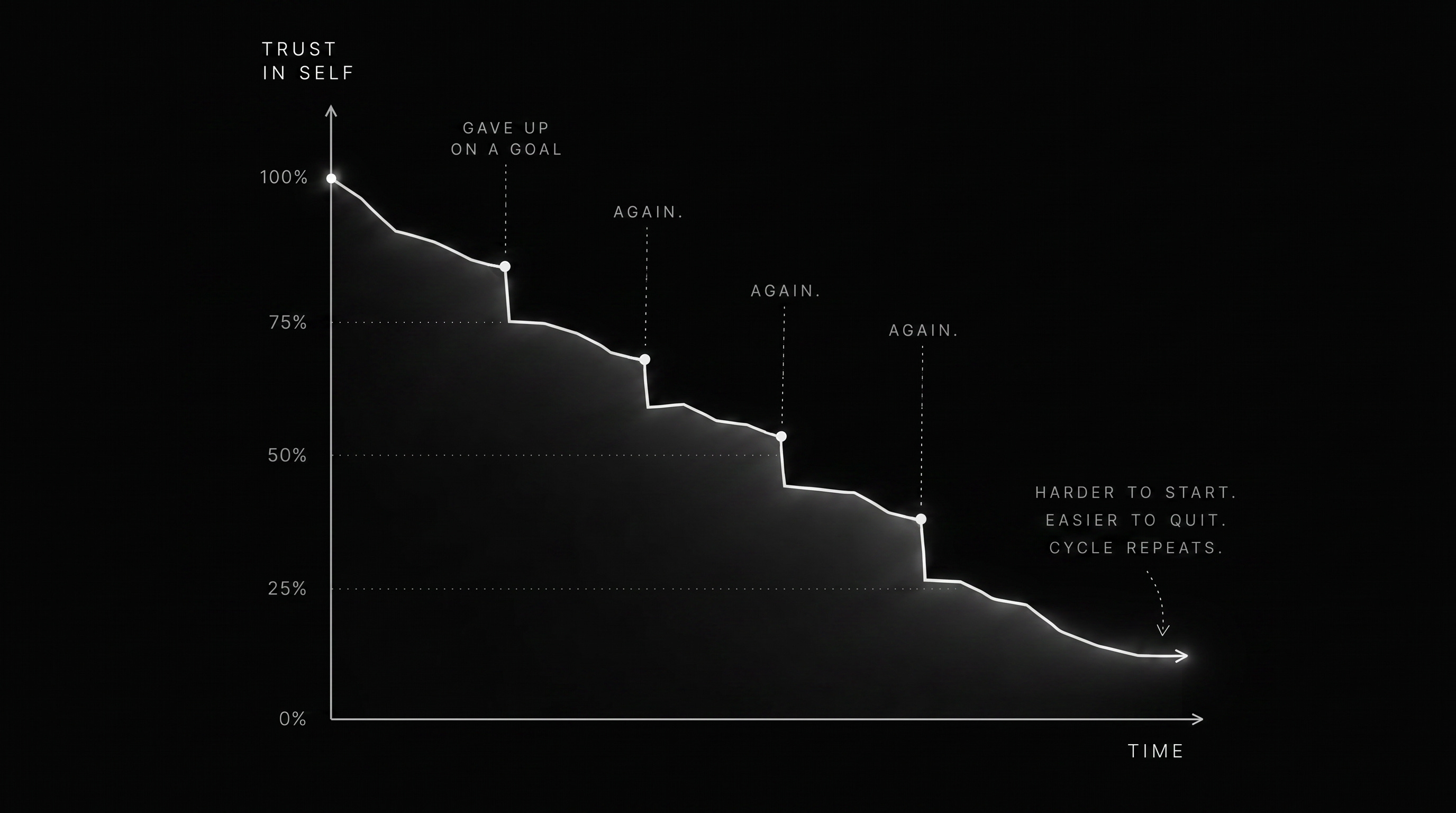
It begins to bleed into everything. Your work. Your relationships. Your sense of who you are. You start to identify as someone who gives up. Someone who can’t follow through.
I think the reason most people can’t do it themselves is simple: it’s overwhelming and uncomfortable. So, there’s resistance. And when there’s no real consequence for quitting other than feeling bad about yourself, so it’s incredibly easy to stop.
It’s Not Your Fault.
From the age of five, your life was structured and handed to you. Someone told you what class to go to, what to learn, when to eat, when to move. You were given projects with deadlines and tests with grades.
School, university and work. It’s all the same. You learn to specialize in executing someone else’s plan. You master doing what you’re told. And now, nobody is telling you what to do with your own life.
This is what school was designed to create: obedient workers who show up on time and follow instructions. It was never designed to produce self-directed human beings. So it never taught you the one thing that would have made a difference.
There’s a concept in psychology called learned helplessness. In the late 1960s, Martin Seligman and Steven Maier ran an experiment on dogs. One group received electric shocks they could stop by pressing a panel. A second group got identical shocks, but nothing they did made any difference.
(Yes. Fuck those guys. I love dogs.)
Later, both groups were put in a box where the escape was easy. Just step over a low barrier. The first group stepped over. Most of the second group just lay down and took the shocks.
The story, the one you’ve probably heard, goes like this: the second group learned to be helpless. They were conditioned to believe nothing they did mattered.
For fifty years, that was the explanation.
But in 2016, Maier and Seligman published a paper that said they’d had it backwards the whole time. The neuroscience showed something different. Turns out, passivity is not learned, it is the brain’s default. The automatic, biological response to prolonged stress is to shut down and stop trying. The second group of dogs didn’t learn helplessness. They just did what brains do when nothing they do makes a difference. They gave up.
The first group was the more interesting one. They learned that pressing the panel stopped the shocks. Their actions changed the outcome. And that experience physically rewired their brains. It overrode the default reaction of helplessness. When they got put in the new box, their brain already knew the pattern: try something, it might work. So they tried it.
So, this is good news. You’re not broken. The system didn’t do this to you. This is just how your brian is wired to deal with overwhelm and stress. School and work just reinforced the default setting instead of teaching you to overcome it. It kept you in a box where nothing you do seems to change anything. You couldn’t control your schedule. You couldn’t opt out. Your brain did what brains do. It shut down and waited for instructions.
The thing is, we can use this to our advantage. The same thing keeping you stuck is exactly how to fix it.
You already know how to respond to structure. Someone tells you what to do, gives you a deadline, and you deliver. You’ve been doing it since you were five. You’re very good at it. The thing that suppressed your agency is also the thing that taught you how to operate inside a system. So before you unlearn the habits that were drilled into you from an early age, you can learn to work with them.
The same structure that made you low agency is the structure that will rebuild it. You just have to choose it this time.
Outsource Your Accountability.
Most people treat their own goals like they don’t matter. There’s no test. No consequence except a vague feeling of disappointment that you’ve learned to numb.
The fix is to manufacture the test.
Find someone to tell you what to do.
Your boss tells you what to do and you do it without question.
So, why is it when it comes to your own goals you can’t do it? Because you don’t know what you don’t know. You don’t know what questions to ask when there is no set of instructions to follow.
I spent seven years in the gym making zero visible progress because I didn’t know what I was doing wrong. I was consistent. I was putting in the effort. But I had no feedback loop. Nobody was looking at what I was doing and saying “that’s not working, try this instead.”
Learning is a cybernetic process. The word comes from the Greek kybernētēs, meaning steersman. If we treat learning like steering a ship, the person at the wheel doesn’t point it in one direction and walk away. They constantly read the current path, compare it against the intended course, and adjust. When you’re doing it alone, you have no one to read the current situation. No one to tell you what you’re doing wrong.
A good teacher or mentor collapses years of mistakes into weeks of clarity.
This would be a good place to promote my coaching offer. Lucky for you, I don’t have one. But you can subscribe if you like.
Raise the stakes.
This is the most important part.
If you fail a test at school, you get a bad grade and you’re in trouble with your parents. If you miss a deadline at work, you risk getting laid off.
It’s funny looking back now how little those things matter but for the sake of this argument, let’s pretend they do.
Now think about the things you actually want. Getting in shape. Starting the business. Making the YouTube video. Nobody’s grading it. Nobody sends a warning email. You can skip a week, a month, a year, and the only person who notices is you and you’re very good at forgiving yourself.
It’s not an information problem. You’ve watched countless tutorials on things you want to achieve, and yet nothing’s changed. Everything you need to know is already free. If information were all we needed, we’d all be rich, jacked, and in great relationships.
You won’t care if you have nothing to lose. You need real consequences. That’s why you need to raise the stakes.
The easiest way to do this is by putting money on the line. Losing money works better than making it. Loss aversion is one of the most powerful forces in human psychology. If you pay someone to hold you accountable, you’re not just investing in their expertise. You’re raising the stakes. You’re creating a consequence for quitting that your brain actually understands.
Online coaches and course sellers get a lot of hate. But there’s a reason they exist. People pay them because they work. If you know who you’re paying, if you trust them, and if they’ve got proven results for other people, it’s worth it. Even if all it does is give you the motivation to actually start.
I would have probably quit by now if I hadn’t paid someone to help me with this. I’m eight weeks in. I’m hungry all the time. I feel skinny. I’ve wanted to eat a burger multiple times. But I paid for this. The money is already gone. So I show up.
If you don’t have the money for a coach or a course, there’s a simple workaround. Give a friend some money and tell them: if I don’t complete this by X date, you keep it. It needs to be enough that you would be stupid to just give away. The amount doesn’t matter as much as the fact that it’s a real loss if you don’t follow through.
Another way to raise the stakes is to set a deadline.
Every test at school had a date you had to take it. Every project at work has a deadline. Why would you treat everything else in your life any different?
A deadline also makes the goal feel achievable rather than treating it like a lifelong practice. Yes, the best things in life are infinite games. But when you’re trying to build momentum, you need a finish line. Twelve weeks. Six months. Something you can see the end of.
Nobody Cares More About You Than You.
The point of this letter isn’t to outsource your entire life so other people do it for you. That would mean your life is their life. It’s not.
It’s about outsourcing the accountability to get you over the initial resistance. To teach you what you need to know. To build the habits so you can live your life without needing anyone to hold your hand.
I’m only eight weeks in and I’ve already learned more about nutrition, calories, macros, and lifting technique than I did in seven years of winging it by myself. I feel different. Not just physically. Something else has shifted. I feel more in control of my life, even though someone is telling me what to do.
You don’t need to focus on everything all at once, but it’s why so many people recommend working on your fitness and health before anything else.
Eventually it will snowball effect to other ares of your life. You start to build trust in yourself again. Because you are still the one doing the work. Nobody lifts the weights for you. Nobody starts the business for you. Nobody shows up for you. You outsource the accountability to get started, to learn what you need to learn, to experience what it feels like when your actions actually have consequences. Then you take back control of your own life.
Nobody cares more about your life than you do. So take some accountability. Outsource your accountability until you no longer need help. Then prove to yourself that you’re not the kind of person who gives up.